Blog
The Polish Real Estate Market in 2026: Housing Construction Accelerates. What Does the New GUS Data Reveal?

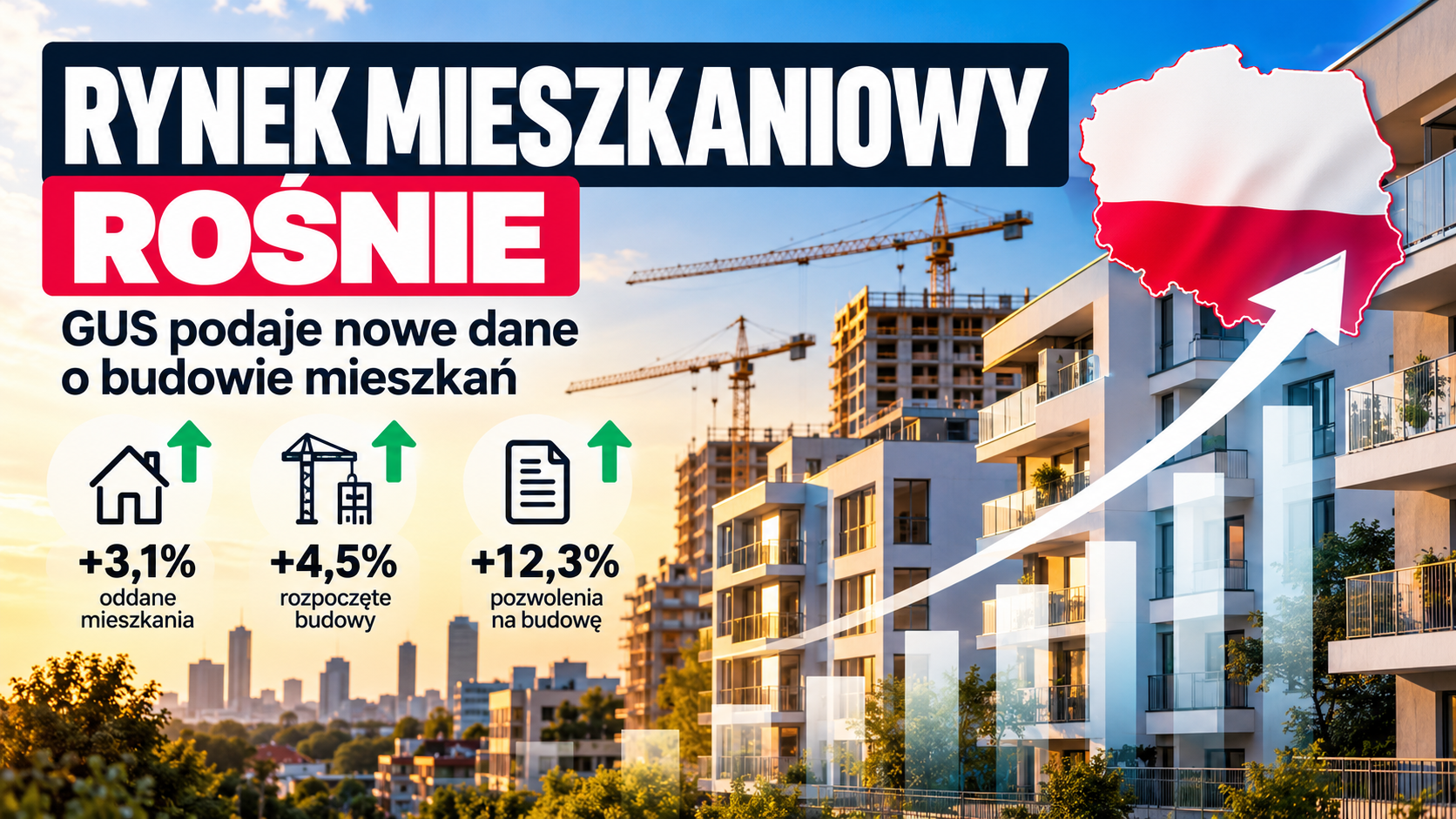
The Polish real estate market is showing signs of recovery in 2026. According to preliminary data from the Main Statistical Office of Poland (GUS), 149,200 apartments were commissioned in the country in the first nine months of the year. This is 3.11% more than in the same period in 2025.
At the same time, the number of new construction projects and building permits has increased. Developers are actively preparing for future investments, and private investors continue to build their own homes.
However, does the increase in construction mean that apartments in Poland will soon become cheaper? And is it worth buying real estate now if the goal is to preserve capital, buy a home for a family, or generate rental income?
To answer these questions, it is necessary to consider not only the number of apartments built, but also other indicators: the number of construction projects started, permits issued, the geography of new investments, and the characteristics of the construction cycle.
Key figures on the Polish real estate market for January–September 2026
According to preliminary data from GUS, in the first nine months of 2026, key indicators of housing construction in Poland were higher than a year earlier.
| Indicator | Results for the first 9 months of 2026 | Change per year |
|---|---|---|
| Apartments commissioned | 149.2 thousand. | +3,1% |
| Construction of apartments has begun | 173.6 thousand. | +4,5% |
| Construction permits for apartments | 216.0 thousand. | +12,3% |
| Apartments under construction at the end of September | 863.1 thousand. | +0,8% |
Source: GUS, preliminary data for January–September 2026.
These figures show that the market is not limited to the completion of previously launched projects. The number of new investments is also increasing, potentially increasing the housing supply in the future.
The increase in the number of building permits is particularly noticeable. This is an important indicator for understanding developers' plans, although several months can pass between obtaining a permit and the actual start of construction.
It should be noted that a permit does not guarantee the project's implementation, and the commencement of construction does not mean that the apartment will be handed over to the buyer in the near future.
Who builds more housing in Poland – developers or private investors?
The Polish housing construction market consists of several segments. The main players are developers building apartments for sale or rent, and private investors constructing housing primarily for their own use.
Developers are increasing the number of new projects
From January to September 2026, developers commissioned 91,900 apartments. This is 1.21% more than in the same period last year.
At the same time, construction permits for 141.9 thousand apartments were issued for development projects – 16.61 TP3T more year-on-year.
The number of construction projects started in this segment reached 103.2 thousand, an increase of 3.11 TP3T.
Thus, the increase in permits significantly outpaces the growth in the number of completed apartments. This is explained by the fact that these indicators reflect different stages of the investment process.
First, the company plans the project and obtains the necessary documents, then begins construction, and only after some time does it hand over the completed apartments to buyers.
If these new projects are completed, the supply of housing on the new build market may increase. However, it is too early to determine how significantly this will impact prices.
Private investors continue to build their own homes.
In the first nine months of 2026, individual investors commissioned 51.3 thousand apartments and houses, which is 5.21 TP3T more than the previous year.
The number of construction starts in this category amounted to 65.4 thousand, an increase of 4.11 TP3T year-on-year.
Individual investors accounted for 69,000 building permits, representing an increase of 6.7%.
These data indicate that private construction remains active. For many families, owning a home remains an alternative to buying an apartment in a large city.
The decision to build depends not only on the cost of land and building materials, but also on the availability of financing, the cost of work, the project implementation timeframe, and the possibility of connecting utilities.
Why doesn't increased construction automatically mean lower apartment prices?
This is one of the main questions for people who are planning buying real estate in Poland.
At first glance, it all seems logical: if more housing is built, supply increases, meaning prices should fall. But the real market is more complex.
Months and years pass between the building permit and the finished apartment.
A building permit is not a ready-made apartment that you can immediately buy and move into.
Once the permit is received, the developer must arrange financing, carry out preparatory work, carry out construction, and complete the necessary procedures before handing over the property to buyers.
Therefore, an increase in the number of permits today may only impact the number of available apartments in future periods.
In addition, some projects may be postponed to a later date or not implemented in their original form.
Housing supply is only one side of the market
Prices are also influenced by:
- availability mortgage loans;
- the level of interest rates and bank requirements for borrowers;
- population income and employment;
- cost of land and building materials;
- labor costs in construction;
- migration and internal population displacement;
- rental demand;
- the attractiveness of a particular city or area.
For example, an increase in the supply of apartments in a city with limited population growth may have a different impact on the market than a similar increase in construction in a rapidly developing economic center.
Even within a single city, the situation can vary significantly: apartments near transport, workplaces, and infrastructure will not necessarily behave the same as properties on the outskirts.
Therefore, the growth of construction should be seen as one of the factors influencing the market, and not as evidence of a future fall in prices.
How many apartments are being built in Poland and what does the figure of 863.1 thousand mean?
According to GUS estimates, 863,100 apartments were under construction at the end of September 2026. This is 0.81% more than at the end of September 2025.
This indicator reflects the scale of construction activity in the country. However, it cannot be directly interpreted as the number of apartments that will be put up for sale in the coming months.
This figure includes projects at various stages of implementation. Some projects may be near completion, while others are in the early stages of construction.
For a buyer of a new building, it's important to pay attention not only to general statistics, but also to the specific property:
- what stage is the construction at;
- What is the deadline for handing over the apartment as stipulated by the contract?;
- What documents does the developer have?;
- How are settlements and protection of buyer funds organized?;
- Are there any consequences of delay provided for in the contract?;
- How realistic is the stated completion date for the work?.
National data helps provide insight into market direction, but is not a substitute for due diligence on a specific investment.
In which regions of Poland is the most housing being built?
Construction activity is distributed unevenly across the country. According to GUS data for the first nine months of 2026, the Mazowieckie, Lesser Poland, and Silesian voivodeships hold the leading positions in key housing construction indicators.
The Masovian Voivodeship is the leader in construction volumes
In the Masovian Voivodeship during the period under review:
- 29.3 thousand apartments were put into operation;
- construction permits for 40.3 thousand apartments were issued;
- Construction of 34.1 thousand apartments has begun.
The region occupies leading positions in all three indicators.
For the market, this means a high concentration of residential investment. However, a large number of apartments under construction does not in itself guarantee housing affordability: land prices, demand, household incomes, and differences between Warsaw and other towns in the voivodeship must be taken into account.
The Lesser Poland Voivodeship remains highly active
In the Lesser Poland Voivodeship, 15,800 apartments were commissioned between January and September 2026. Projects for 21,200 apartments received permits, and construction began on 18,300.
The region remains one of the largest centers of housing construction. When evaluating specific properties here, it is especially important to compare individual cities and districts, as overall indicators for the voivodeship do not reflect all local differences.
Silesian Voivodeship - significant volume of permits
In the Silesian Voivodeship, 12.6 thousand apartments were commissioned, construction permits were issued for 23.6 thousand, and construction began on 14.7 thousand.
The number of permits issued significantly exceeds the number of construction starts. However, these figures do not necessarily relate to the same projects: permits issued this year may lead to construction starting later.
What does this mean for buyers?
Regional indicators are useful for understanding the market overall, but choosing properties based solely on construction volume is not a good idea.
The buyer should analyze the specific city, area, transport accessibility, infrastructure, cost of housing maintenance and the prospects for using the property.
For an investor considering a rental apartment, potential tenant demand, maintenance costs, and possible downtime are additionally important factors.
Is it worth buying an apartment in Poland now?
Statistics for January–September 2026 show an increase in housing construction. However, the decision to purchase should depend primarily on personal financial capabilities and the purpose of the purchase.
If you need an apartment for your own use
If you plan to live in your apartment for many years, it's worth considering not only the likelihood of price changes, but also the quality of life.
The neighborhood, transportation, schools and kindergartens, jobs, utility costs, and the ability to comfortably service a mortgage are all important.
Waiting for a more favorable market situation also has its price: during this time, the buyer may continue to rent the property, and lending terms and prices may fluctuate in different directions.
Therefore, there's no universal answer to whether it's worth buying an apartment now. It's more important to determine a comfortable budget and check whether the family budget can withstand potential financial changes.
If you are buying an apartment for rent
It is important for an investor to evaluate not only the potential growth in property value, but also rental income.
You need to take into account the purchase price, finishing, furniture, taxes, insurance, repairs, administrative fees and possible periods when the apartment is left without a tenant.
An increase in housing supply may intensify competition among landlords in certain areas. In this case, the apartment's location, layout, and suitability to potential tenants' needs are particularly important.
However, national construction statistics alone do not allow us to determine how much rental rates will change in a particular city.
If you are considering purchasing a new building
When choosing a new building, it is worth comparing not only the price per square meter, but also the total purchase price.
It may include finishing, parking space, storage room, additional payments and transaction costs.
It is also necessary to check the contract, the deadlines for handing over the apartment, the developer's documents, and the payment procedure.
The availability of a large number of new projects expands the choice, but does not eliminate the need to check the specific object and the terms of the contract.
What's next for the Polish real estate market?
Data for the first nine months of 2026 shows that the housing construction market has become more active compared to the same period last year.
The most significant increase was in the number of construction permits issued. At the same time, the number of construction projects started and apartments commissioned increased.
However, these changes do not allow us to reliably predict price movements in the coming months. To do this, we also need to monitor demand, lending availability, the number of offers on the market, and price dynamics in individual cities.
Buyers should consider their own financial capabilities, and investors should calculate the profitability of a specific property, taking into account expenses and risks.
In the coming months, it will be useful to monitor the following indicators:
- Number of apartments commissioned.
- Number of new permits and construction starts.
- Changes in mortgage rates and credit availability.
- Price dynamics in the primary and secondary markets.
- The number of available offers in a particular city.
- Rental prices and actual profitability of investment apartments.
It is the combination of these factors that will help to better assess the state of the market than a single statistical indicator.
Frequently Asked Questions about the Polish Real Estate Market in 2026
How many apartments were built in Poland in the first nine months of 2026?
According to preliminary data from GUS, 149,200 apartments were commissioned from January to September 2026. This is 3.11% more than in the same period in 2025.
How many apartment construction permits have been issued in Poland?
In the first nine months of 2026, construction permits were issued or related procedures completed for 216,000 apartments. This represents an increase of 12.31% compared to the same period last year.
Does increased construction mean that apartments will become cheaper?
No, it's impossible to draw a definitive conclusion. Increased supply can influence prices, but the outcome also depends on demand, mortgage terms, construction costs, and the situation in a particular region.
In which voivodeship of Poland is the most housing being built?
According to data for January–September 2026, the Masovian Voivodeship was the leader in terms of the number of apartments commissioned, permits issued, and construction projects started.
Is it worth buying an apartment in Poland in 2026?
The decision depends on the purchase purpose, budget, financing terms, and property characteristics. General statistics help assess market trends but are not a substitute for individual financial calculations.
Conclusions
The Polish real estate market is showing an increase in residential construction activity in 2026. In the first nine months of the year, the number of apartments commissioned increased by 3.11%, the number of construction starts by 4.51%, and the number of building permits by 12.31%.
These data indicate an expansion of construction activity, but do not provide grounds for asserting that apartment prices will necessarily decrease or increase in the near future.
It is important for buyers to consider their own needs and financial capabilities, and for investors to evaluate a specific property, potential profitability, and expenses.
The real estate market consists of many local markets, so purchasing decisions are best made based on a combination of statistics, analysis of the specific city, and a thorough inspection of the property itself.
Sources:
- Business Insider Polska - «Rynek mieszkaniowy rośnie. GUS podaje nowe dane o budowie mieszkań»: https://businessinsider.com.pl/nieruchomosci/rynek-mieszkaniowy-rosnie-gus-podaje-nowe-dane-o-budowie-mieszkan/4tklmkh
- Główny Urząd Statystyczny - «Budownictwo mieszkaniowe w okresie styczeń–wrzesień 2026 r.»: https://stat.gov.pl/obszary-tematyczne/przemysl-budownictwo-srodki-trwale/budownictwo/budownictwo-mieszkaniowe-w-okresie-styczenwrzesien-2026-r-%2C5%2C180.html